At the June General Assembly of ICOM, held at the UNESCO headquarters in Paris, a number of decisions were made which will affect ICOM UK members. The General Assembly is ICOM’s main decision-making body. Composed of representatives from ICOM’s global network, it is responsible for setting statutes, electing the Executive Board, and adopting strategic plans and ethical standards for museums worldwide.
After five years of development, the revised Code of Ethics was approved. The long consultation, orchestrated the ICOM Ethics Committee, which includes in its members Steph Scholten, Director of the Hunterian Museum and also member of ICOM’s Executive Bord, was participative and based on dialogue. 114 committees, including several rounds of consultation involving ICOM UK members, as well as outside experts were involved in its inception. The resulting new Code is a reflection of common ethical values. Translation into all three official ICOM languages was a very important part of the process and resulted in improved common understanding and further refinements. ICOM is now working on developing associated guidelines as an ethical framework to operate within, and to facilitate better practical understanding for members.
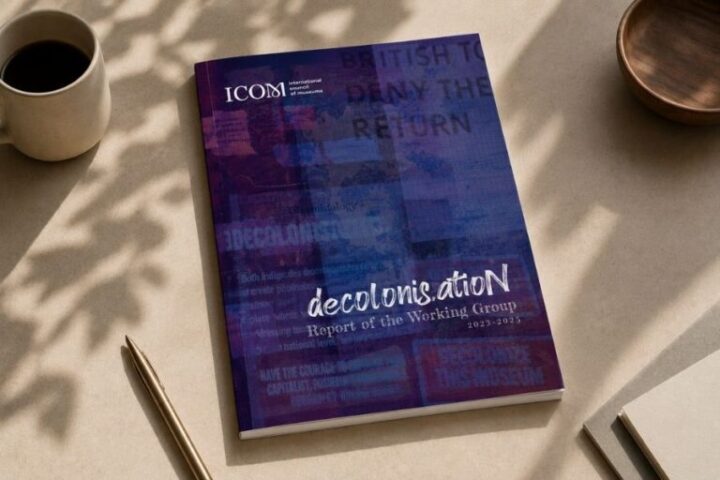
Second, the formation of a new Standing Committee on Decolonisation was announced, building on the work in the past three years of the Decolonisation Working Group, which had been including ICOM UK’s Board member, Abeer Eladany from Aberdeen University Museums. Abeer had been an important driving force behind the recently published report of the Decolonisation Working Group.
Drawing on extensive input the Working Group had gathered from within and outside the ICOM network, the report brings together a set of recommendations outlining how ICOM can engage with and advance these issues. It also offers insight into how decolonisation practices are currently being implemented across museums worldwide, highlighting a diversity of approaches and experiences. In addition, the report undertakes the complex task of articulating what decolonisation means in the context of ICOM and museums, whilst acknowledging and addressing the debates and sensitivities the term encompasses. Importantly, a glossary accompanies the report to support readers in understanding key concepts, as ever with the nuanced approach that marks ICOM as a trusted partner across the world.
Standing Committees and Working Groups are mandated by the President and the Executive Board to give advice and provide expertise on essential aspects of the association and on subjects of importance for the global museum community. While the mandate of a Working Group is time limited, a Standing Committee is permanent. Both Standing Committees and Working Groups unite ICOM’s international experts to assess reforms and rules that contribute to the efficiency of the management of ICOM. The new members of the Standing Committee on Decolonisation will be announced during July.
Thirdly, an ICOM UK recommendation was adopted last week which will pave the way for easier inclusion of displaced persons as ICOM members. Under current ICOM membership rules, individuals applying for membership must be working or retired museum professionals, or provide services, knowledge and expertise for museums, as their main professional activity. This criterion is difficult to prove by colleagues who have been displaced, by armed conflict or for other reasons, from their home country or territory. By definition, they would often lose their jobs, and with that their eligibility to become or remain an ICOM member.
ICOM UK has been trying for several years to find a way that would enable displaced museum professionals seeking refuge in the UK to become ICOM members. The recommendation drafted by ICOM UK (jointly with AVICOM, the International Committee for Audiovisual, New Technologies and Social Media) calls for ICOM to introduce more flexible approaches to demonstrating professional status, and promote equitable access to participation in ICOM activities regardless of nationality or location.
Recommendations are proposed by National or International Committees, and voted on by members of ICOM’s Advisory Council. While non-binding, recommendations are submitted to the Executive Board for consideration.
Christian Baars, Co-Chair of ICOM UK.
