In the first of a new series, the devolved nation reps on the ICOM UK Committee talk to colleagues about new museum practice and projects from Wales, Scotland, and the island of Ireland. We start the series with three interviews from the island of Ireland and then Alfredo Camerotti, our Welsh rep will talk to colleagues in Wales. Finally, Duncan Dornan and Jilly Burns will focus on innovative museum practice in Scotland.
Hannah Crowdy, Head of Curatorial for National Museums Northern Ireland (NMNI) talks to Alan Freeburn, currently the Manager of the Northern Ireland War Memorial Museum (NIWM) in Belfast, Northern Ireland.
HC: Would you tell ICOM UK members a little about what you do?
AF: I am currently the Manager of the Northern Ireland War Memorial Museum (NIWM). Normally, I am the Collections Officer at the museum but at the moment I lead a small but dedicated and passionate team of staff to deliver a varied and engaging programme of events, workshops and exhibitions.
HC: What is special about your museum?
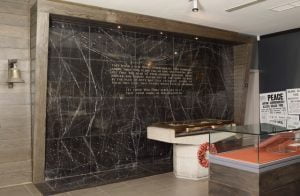 AF: NIWM is Northern Ireland’s only accredited museum dedicated solely to the home front during the Second World War. We tell how Northern Ireland and its people were affected by the Belfast Blitz, how they welcomed, and how they were influenced by, the hundreds of thousands of US and allied service personnel that were based in the country and how NI contributed to the war effort.
Our origins can be traced back to the Second World War itself when plans for a memorial were raised. It was decided that a practical space rather than a statue or monument was to be built through government matched public funding.
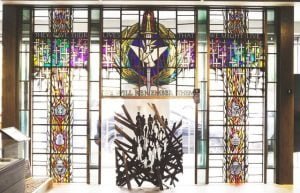
So, although we operate as a museum, we were originally set up to be and continue to act as a memorial to those from Northern Ireland who died in both world wars. Several memorials and artworks are an integral part of our permanent displays within the museum.
As a museum however we are in a fortunate position, as we are situated within Belfast’s thriving Cathedral Quarter we are ideally located for locals and tourists alike.
We may be small in comparison to most museums, but we tell a big story and we punch well above our weight with our programming.
HC What do you see as the main challenges for museums on the island of Ireland in 2021?
AF: The Covid pandemic obviously had a huge impact upon museums; NIWM was only open to the public for 101 days in 2020. Thankfully staff were able to go about their duties whilst working from home but in other areas such as collections, working remotely severely limited what could be achieved.
For museums, I think the main challenge was not to rest on our laurels. The pandemic made us think differently as a sector, not only about how we could work but also how we could continue to engage visitors through new mediums and platforms. Just because we have now physically reopened again does not mean that these methods that proved so useful during lockdown should be forgotten and cast aside. I believe there is now an expectation that museums and similar organisations continue to offer this digital or virtual element alongside more traditional methods of engagement. The challenge will be adapting to meet these new expectations and finding the balance between these methods and what works best for each museum and its audiences.
HC: What do you see as the main opportunities for museums on the island of Ireland in 2021?
AF: My answer here is similar to my previous point in that the pandemic has proven that each museum is not confined to its walls and that each museum is a global museum with a global audience thanks to new mediums and methods of engagement.
Museums have an opportunity to cement their efforts throughout the last year and going forward to think beyond what they had previously deemed as their limits.
HC: 2021 is the 80th anniversary of the Belfast Blitz. Could you tell us more about how the NI War Memorial has commemorated this?
AF: This was a huge event for us that we couldn’t mark as we would normally due to Covid19 restrictions. We were forced to think differently as to how we could mark this anniversary and it would be near impossible for me to touch upon every aspect in detail.
We were able to hold a scaled-back version of our usual commemorative service within the museum where the High Sheriff of Belfast, Michael Long laid a wreath on our Blitz Memorial. Limited services were also held at the two mass graves for the unidentified remains of the victims of the Belfast Blitz at Milltown and Belfast City Cemeteries and the Lord Mayor of Belfast, Alderman Frank McCoubrey laid wreaths in memory of those killed as a consequence of enemy action in April and May 1941.
In a further effort to increase awareness of the Blitz and those killed, we replicated the death notices of the 987 known victims in two of the major daily newspapers, The Newsletter and The Irish News.
 With the support of Belfast City Council, we produced a Blitz 80 Reminiscence Pack and a Blitz 80 Primary School Teacher Resource both of which proved incredibly popular. Aimed at residential homes and daycare centres the Reminiscence Pack included reminiscence guidance, a sing-along CD of wartime songs, a craft activity and utilised sound clips from our oral history collection. The Teacher Resource used items from the museum collection along with primary sources to supplement the curriculum.
Due to the pandemic curtailing many of our normal operations, the time gained enabled staff to conduct new and detailed research into those that were killed in the Blitz. As a result, our major focus was to rehumanise the victims of the Blitz as they are all too often presented as a number or a stat rather than as people who had livelihoods and relationships. After months of research and tracing relatives we had sourced images of approximately a tenth of the victims and were able to put a face to what was previously only a name. This research was then presented as part of a lecture series in partnership with the Public Record Office of Northern Ireland (PRONI) looking at different aspects of the Belfast Blitz. It also features on the memorial page to the victims on our website.
It also led to several tangible donations to NIWM of items belonging to or relating to those killed by the Luftwaffe in 1941.
 We also worked in partnership with Queen’s University Belfast to launch our ‘Mapping the Blitz Project’. Based on the above research along with other sources, an interactive web map will be created that is free to access, investigate and explore. A story map will also be released focusing on the human stories of the Blitz.
Lastly, as a result of a further partnership with National Museums NI and the Imperial War Museums (IWM), we produced and launched a Blitz walking tour of Belfast’s Cathedral Quarter. It features photos of the aftermath of the raids to enable users to compare then and now alongside a downloadable audio guide. Although produced and released with the 80th anniversary of the Blitz in mind, many of the above resources were designed to be used at any point during the year and will continue to be offered in the future once normality resumes.
HC: What should we look out for at your museum over the next 12 months?
 AF: As a museum that has a confined remit; Northern Ireland between the years of 1939-45, our programming is largely based on anniversaries of events that occurred during the Second World War.
Our immediate focus will be commemorating the 80th anniversary of the official arrival of American personnel in Northern Ireland and the European Theatre of Operations in January 2022. We have a number of plans currently in development including a film screening, book launch and family fun day. Additionally, the anniversary of the Belfast Blitz will continue to be marked in April and May 2022
We also have some exciting plans and events to mark LGBT History Month in February 2022.
Most of all we are looking forward to the resumption of our popular and busy schools programme and showpiece events such as Culture Night next year.
